Spiritual Compass
Your relationship with the sacred, from devout faith to secular humanism
Free, no account needed.
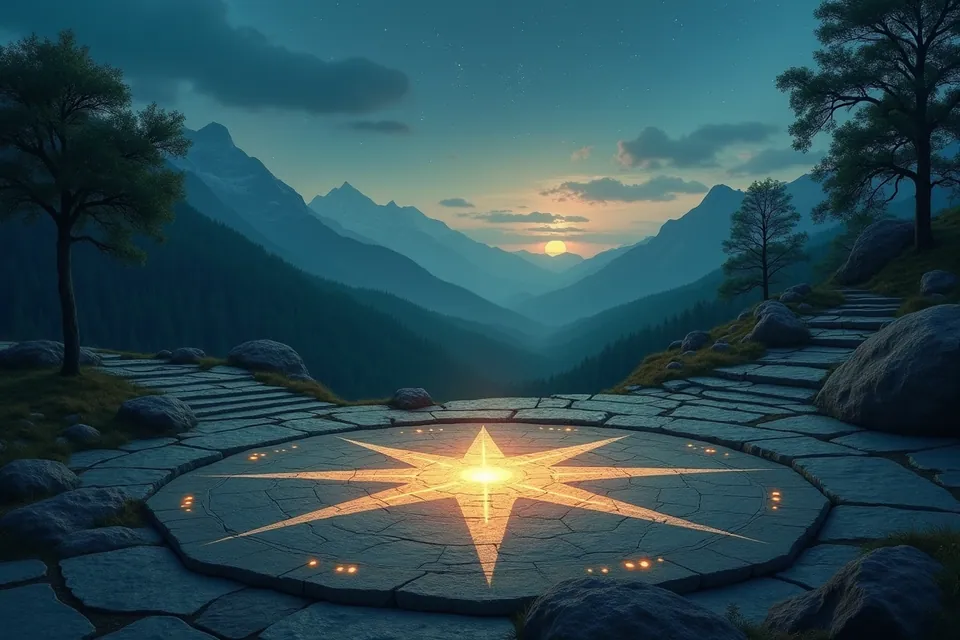
This test explores your relationship with the sacred, whatever that word means to you: belief in God, experiences of something beyond yourself, ritual and community, trust in natural explanations, openness to questions, and reverence for nature. It is written for people of every faith and of none.
There are no better or worse answers, and no result ranks above another. Answer about what you actually believe and do, not what you feel you should. If a word does not fit your tradition, such as prayer or God, translate it into your own terms, or answer as the statement stands if it simply does not apply to you.
What it measures
Personal God
Belief in, and a felt relationship with, a God who knows, cares and responds.
Low: You do not believe in a personal God, or find the idea unconvincing or unimportant for your life.
High: You believe in a God who knows and loves you, and that relationship is central to your life.
Transcendence
Experiences of unity, presence or awe that seem to reach beyond the ordinary self, and practices that cultivate them.
Low: You live mostly in ordinary, practical reality and rarely, if ever, have experiences you would call mystical.
High: You have known moments of deep unity or presence, and silence or contemplation matters to you.
Practice and community
Ritual, tradition, sacred texts and belonging to a community of shared faith or practice.
Low: You approach the big questions on your own terms, with little need for ritual, institution or congregation.
High: Rituals, holy days and a community of shared practice shape your life and connect you to the generations.
Naturalism
Trust in science and natural explanations, and skepticism about miracles and supernatural forces.
Low: You believe in realities beyond the natural world: spiritual forces, miracles, a life beyond this one.
High: You expect everything to have a natural explanation and side with science when it conflicts with doctrine.
Seeking
Openness, questioning and doubt: treating the big questions as a journey rather than a settled answer.
Low: You feel settled in your answers to life's big questions and see little need to keep searching.
High: Your views are still evolving; you learn from many traditions and treat doubt as part of honesty.
Sacred nature
A sense that the sacred is present within nature and the world, and kinship with all living things.
Low: Nature may be beautiful to you, but you would not call it holy; the sacred, if anywhere, lies elsewhere.
High: You experience nature as sacred and feel deep kinship with the living earth.
Possible results
 The Devoted Heart
Faith as a living relationship with a God who is near.
 The Contemplative
Seeking the silent depth where the self and the sacred meet.
 The Hearth-Keeper
Faith lived through ritual, belonging and the wisdom of generations.
 The Pilgrim
Always on the road toward a truth worth finding.
 The Unbound Spirit
Deeply spiritual, freely so, beyond the walls of any institution.
 The Nature Mystic
The sacred is here: in forests, rivers, stars and living things.
 The Rational Believer
A creative intelligence behind the cosmos, reached by reason.
 The Open Question
Honest not-knowing, held with curiosity and calm.
 The Humanist
A good life of reason, compassion and community, without the supernatural.
 The Clear-Eyed Skeptic
Proportion belief to evidence, and follow the argument where it leads.
 The Stargazer
Reverence for a universe that needs nothing supernatural to be sacred.
About this test
The psychology of religion has long treated faith as many-sided. The sociologists Charles Glock and Rodney Stark distinguished belief, practice, experience, knowledge and consequences; William James's The Varieties of Religious Experience made mystical experience a subject of study; later researchers measured devotion held for its own sake, open-ended spiritual questing, mystical experience and reverence for nature, and charted the growth of people who describe themselves as spiritual but not religious.
This test measures six dimensions: belief in a personal God, transcendent experience, practice and community, naturalism (trust in natural explanations), seeking (openness and doubt) and immanence (the sacred within nature and the world). All items are original. Each dimension is measured by statements keyed in both directions, plus a few forced choices. Your profile is compared with eleven typical orientations, and the nearest becomes your result; a map places you between spirit-centred and science-centred outlooks and between a personal path and a shared tradition.
Caveats: this is a tool for self-reflection, not a measure of how religious or spiritual anyone really is, and not a judgement of any belief or tradition. Orientations blend, and many people sit between two. Scores are relative to the range of possible answers, not to population norms, and words such as God, sacred and prayer carry different meanings across traditions.
References
- James, W. (1902). The Varieties of Religious Experience. New York: Longmans, Green.
- Glock, C. Y. & Stark, R. (1965). Religion and Society in Tension. Chicago: Rand McNally.
- Allport, G. W. & Ross, J. M. (1967). Personal religious orientation and prejudice. Journal of Personality and Social Psychology, 5, 432-443.
- Batson, C. D., Schoenrade, P. & Ventis, W. L. (1993). Religion and the Individual: A Social-Psychological Perspective. Oxford University Press.
- Hood, R. W. (1975). The construction and preliminary validation of a measure of reported mystical experience. Journal for the Scientific Study of Religion, 14, 29-41.
- Fuller, R. C. (2001). Spiritual, but not Religious: Understanding Unchurched America. Oxford University Press.
For self-reflection and curiosity, not diagnosis. Scores describe how you answered, relative to the possible range; they are not compared with population norms.
Spiritual Compass
About 5 minutes · 38 questions
More tests in this area
- Philosophical Worldview
Answer the big questions and meet the philosophers who agree with you
50 questions · About 13 minutes
- Thinking Style
Analytical, intuitive, creative or practical?
34 questions · About 5 minutes
- Time Perspective
Do you live in the past, the present or the future?
35 questions · About 5 minutes